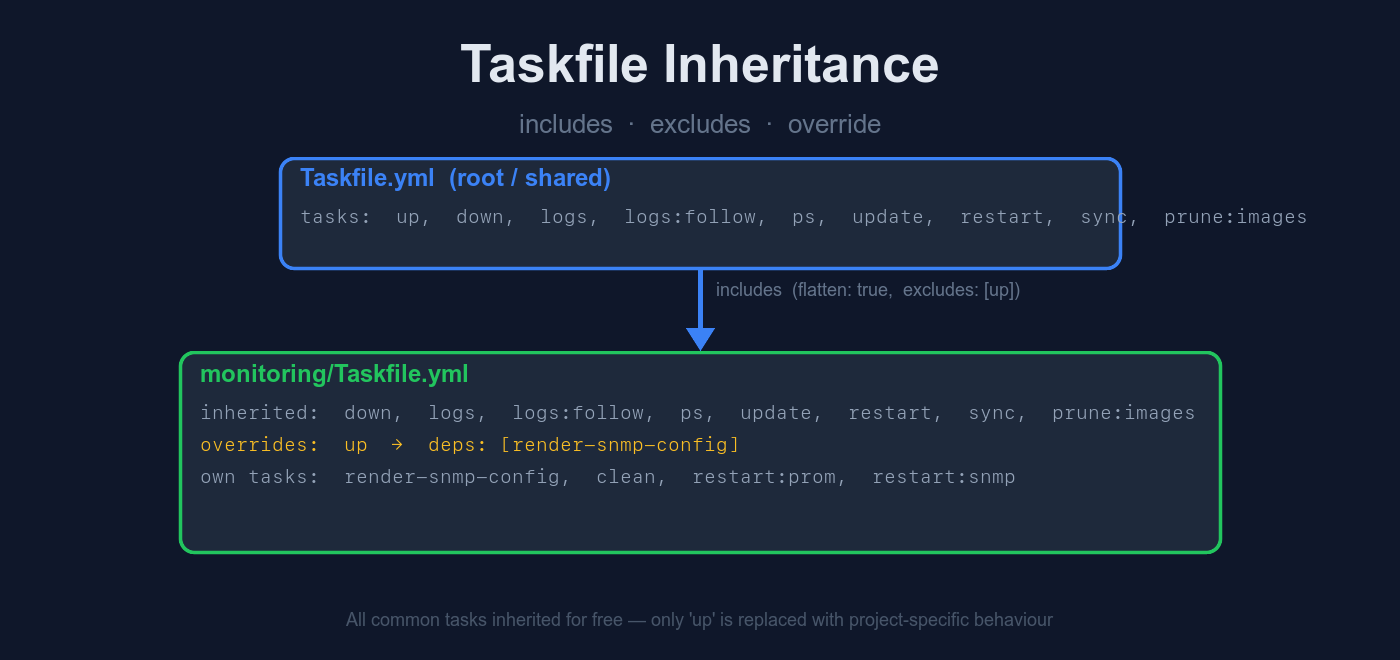
In a previous post I showed some Taskfile magic for working with docker compose. That post covered the DOCKERCOMPOSE variable trick and a set of reusable tasks for managing containers. This post picks up where that left off: what do you do when you have multiple projects that all need those same tasks, but one of them needs to behave slightly differently?
The shared root Taskfile
My dockers repository has a root Taskfile.yml that defines common docker compose tasks. Every sub-project (monitoring, paperless, pihole, …) can reuse them. The relevant part looks like this:
vars:
  DOCKERCOMPOSE: "docker compose"
  DOCKER_COMPOSE_FILE: "compose.yml"

tasks:
  up:
    desc: "Start the docker-compose environment"
    dir: "{{.USER_WORKING_DIR}}"
    preconditions:
      - test -f {{.DOCKER_COMPOSE_FILE}}
    cmds:
      - "{{.SUDO}} {{.DOCKERCOMPOSE}} up -d --remove-orphans"

  down:
    desc: "Stop the docker-compose environment"
    # ...

  logs:
  ps:
  update:
  restart:
  # ... and more
Having this in one place means every sub-project gets up, down, logs, ps, update, and restart for free — without copying anything.
Including it in a sub-project
Taskfile has an includes directive that lets you pull another Taskfile into yours. Combined with flatten: true, all tasks from the included file land directly in the current namespace — no prefix needed.
includes:
  root:
    taskfile: ../Taskfile.yml
    flatten: true
With this, running task up inside monitoring/ works exactly as if the root tasks were defined locally. All the shared tasks just work.
The problem: name collision
The monitoring stack has a requirement the other projects don’t: before starting the stack, it needs to render a config file from a template, substituting SNMP credentials from a .env file. The natural place to hook this in is the up task.
But if both the root Taskfile and the monitoring Taskfile define up, Taskfile will complain about a duplicate task definition. A plain include doesn’t let you replace tasks — it only adds them.
The excludes option
This is exactly what excludes is for. Adding it to the includes block tells Taskfile: “import everything from this file, except these tasks.”
includes:
  root:
    taskfile: ../Taskfile.yml
    flatten: true
    excludes: [up]  # don't import this one, we define it ourselves
Now the root up is never imported, so the monitoring Taskfile can define its own without any conflict. All other tasks — down, logs, ps, update, restart — are still inherited as-is.
The local up override
With the slot free, the monitoring Taskfile defines its own up:
tasks:
  up:
    desc: Render config then start stack
    deps: [render-snmp-config]
    cmds:
      - "{{.SUDO}} {{.DOCKERCOMPOSE}} up -d --remove-orphans"
The deps line ensures render-snmp-config always runs before the stack starts. That task reads .env secrets and substitutes them into the SNMP exporter config template:
  render-snmp-config:
    desc: Render snmp-exporter config from template using .env secrets
    cmds:
      - |
        set -a && source .env && set +a
        sed -e "s|\${SNMP_USERNAME}|$SNMP_USERNAME|g" \
            -e "s|\${SNMP_PASSWORD}|$SNMP_PASSWORD|g" \
            snmp-synology/snmp.yml.template > snmp-synology/snmp.yml
    sources:
      - snmp-synology/snmp.yml.template
      - .env
    generates:
      - snmp-synology/snmp.yml
Bonus: idempotency with sources and generates
Notice the sources and generates fields on render-snmp-config. Taskfile uses these to track whether the task’s inputs have changed since the last run. If neither the template nor the .env file has been touched, Taskfile skips the render entirely — a small but nice efficiency when you’re doing task up repeatedly during development.
The complete monitoring Taskfile
Here’s the full monitoring/Taskfile.yml — clean and to the point:
version: "3"

includes:
  root:
    taskfile: ../Taskfile.yml
    flatten: true
    excludes: [up] # don't import this one, we define it ourselves

tasks:
  render-snmp-config:
    desc: Render snmp-exporter config from template using .env secrets
    cmds:
      - |
        set -a && source .env && set +a
        sed -e "s|\${SNMP_USERNAME}|$SNMP_USERNAME|g" \
            -e "s|\${SNMP_PASSWORD}|$SNMP_PASSWORD|g" \
            snmp-synology/snmp.yml.template > snmp-synology/snmp.yml
    sources:
      - snmp-synology/snmp.yml.template
      - .env
    generates:
      - snmp-synology/snmp.yml

  clean:
    desc: Remove generated snmp-exporter config
    cmds:
      - rm -f snmp-synology/snmp.yml

  up:
    desc: Render config then start stack
    deps: [render-snmp-config]
    cmds:
      - "{{.SUDO}} {{.DOCKERCOMPOSE}} up -d --remove-orphans"

  restart:prom:
    desc: Restart prometheus container
    deps:
      - render-snmp-config
    cmds:
      - "{{.SUDO}} {{.DOCKERCOMPOSE}} restart prometheus"

  restart:snmp:
    desc: Restart snmp-exporter container
    deps:
      - render-snmp-config
    cmds:
      - "{{.SUDO}} {{.DOCKERCOMPOSE}} restart snmp-exporter"
Conclusion
The includes + flatten + excludes combination gives you clean Taskfile inheritance: share a common set of tasks across all your projects, and selectively replace only the ones that need project-specific behaviour. No duplication, no namespace clutter, and the override is explicit and easy to spot.